


Welcome to the homepage of the European Academic Fluid Power Association
Aim of this Association is the connection of people interested in Fluid Power Teaching, Research and Development and the promotion of visibility of Fluid Power technology.
What is Fluid Power?
Fluid Power involves energy transmission through pressurized working fluids. Alongside mechanical and electrical systems, fluid power is a means of power transmission. It includes hydraulics (liquid as the working fluid) and pneumatics (air/gas as the working fluid), and plays a vital role in modern machinery, automation and transportation.
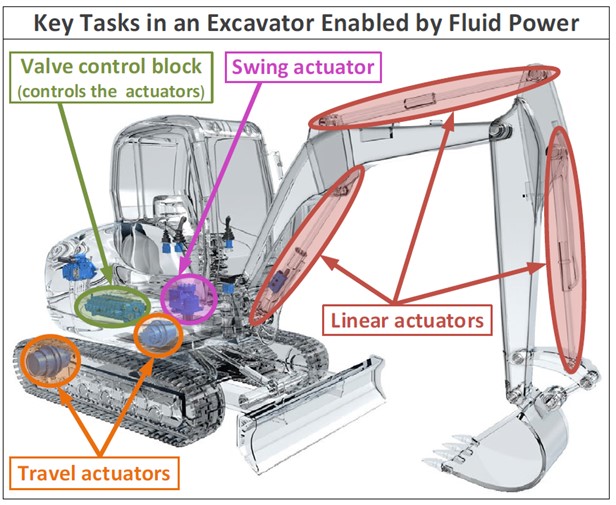
Fluid power technologies are indispensable in applications demanding high power and/or force density, precision and reliability. Fields of applications are virtually countless and include e.g. off-road vehicles as well as on-road vehicles, industrial machinery, aeronautics & aerospace systems, marine systems, renewable energy production systems, civil constructions, medical devices, manufacturing systems and so forth. These are just a few examples of the wide range of applications where fluid power technologies are key enablers, emphasizing the broad versatility of fluid power and its vital role in modern technology. Fluid power technologies improve resilience, functionality and productivity across industries. An example known to many people is an excavator where fluid power is an indispensable enabler for its functionality.
Key challenges for fluid power include low system level energy efficiencies, resulting in excessive energy usage and associated emissions. Whereas todays fluid power components are rather effi-cient, system level working principles have largely remained unchanged for decades. To unlock the decarbonization potential of fluid power technologies, energy efficient fluid power system architectures must be at the heart of research efforts, enabling competitive and sustainable technology.
Why is Fluid Power relevant in context of EU Goals?
To fulfil EU’s ambition of fostering groundbreaking innovation, industrial competitiveness, and sustainability, fluid power technologies must be prioritized. As highlighted in the mission letter to Commissioner Zacharieva, the EU needs investment, cooperation and focus on disruptive innovations. Fluid power is a prime example here, offering transformative potential across industries while addressing CO2 reduction targets. Increasing research allows for the pursuit of the 40% emission-reduction target for 2040 associated with the Clean Industrial Deal as outlined in Europe’s Choice by Ursula von der Leyen. As mentioned in the Draghi report, decarbonization must become a source of growth, and fluid power research will indeed be an enabler in this effort.
To meet the EU’s goals on climate, electrification, and industrial competitiveness, research must address energy efficient fluid power systems and minimize reliance on rare earth elements, while recognizing that each sector has unique needs. Research impact is only achieved through projects with emphasis on active industry/academia collaborations and demonstrations.
We are happy to answer any questions you may have about fluid power technology in research and in teaching and are looking forward collaborating with you!
Contact information:
info_at_europeanfluidpower.org
European Academic Fluid Power Association General Secretariat
c/o Fördervereinigung Fluidtechnik e.V.
Campus Boulevard 30
52074 Aachen, Germany